

If you've ever worked in industries like aerospace, oil and gas, automotive, or semiconductor manufacturing, chances are you've encountered a PTFE ring-even if you didn't know it by name. As a long-time PTFE ring supplier, I've seen firsthand how these unassuming components hold entire systems together, preventing leaks, reducing friction, and withstanding extreme conditions that would destroy most other sealing materials. But what many people don't realize is that "PTFE ring" is a broad term. There are distinct types, each engineered for specific jobs, and picking the wrong one can lead to costly downtime, failed equipment, or safety hazards. Today, I'm breaking down the different types of PTFE rings, their uses, and what makes each one unique-plus, I'll point you to our premium options if you're looking for reliable, precision-machined parts.
First, let's start with the basics. PTFE, or polytetrafluoroethylene, is a synthetic polymer famous for its non-stick properties, chemical resistance, and ability to operate across a wide temperature range (from -200°C to +260°C, roughly). Unlike rubber or metal seals, PTFE doesn't react with most chemicals, oils, or solvents, and it has a very low coefficient of friction-meaning it glides rather than rubs against other parts. That makes it ideal for sealing applications where leakage is unacceptable. But PTFE is soft and prone to cold flow (deforming under constant pressure), so manufacturers add fillers like glass fiber, carbon, bronze, or stainless steel to boost its strength and durability. The type of filler, shape, and design of the ring all determine its purpose.
Let's start with the most common: solid PTFE rings. These are exactly what they sound like-uniformly made from 100% pure PTFE, no additives. Solid PTFE rings are the workhorses of general sealing. They're lightweight, flexible, and easy to machine into custom sizes, which makes them perfect for low-pressure, low-speed applications. Think of them as the go-to for hydraulic systems in small machinery, or as static seals for doors, valves, and pumps where there's minimal movement between parts. The downside? Pure PTFE is soft, so it can wear out quickly under high pressure or heavy friction. If you try to use a solid PTFE ring in a high-pressure hydraulic cylinder, it might flatten out over time, creating gaps that let fluid leak past. For that reason, solid PTFE rings are best suited for static seals or dynamic seals with low motion and pressure under 1,000 PSI. As a supplier, I always recommend solid PTFE rings for simple, low-stakes jobs where cost-effectiveness is key. But if your application involves higher pressure, you'll need something more robust.
That's where filled PTFE rings come in. As I mentioned earlier, fillers transform PTFE's properties, and different fillers serve different needs. Let's go through the most common filled types. First, glass fiber-filled PTFE rings. Adding 10-25% glass fiber to PTFE makes it stiffer and more resistant to wear, while still retaining PTFE's chemical resistance. Glass fiber-filled rings can handle pressures up to 3,000 PSI and operate at slightly higher temperatures than solid PTFE (up to 290°C, depending on the grade). They're often used in rotary applications, like shafts in pumps or motors, where the seal is moving against a metal surface. The glass fiber prevents the ring from deforming under centrifugal force, and it reduces friction so the shaft doesn't wear down prematurely. I've seen glass fiber PTFE rings in action in food and beverage processing plants, where they have to seal acidic or dairy products without contaminating the batch-their non-porous surface and chemical resistance make them perfect for that.
Next up is carbon fiber-filled PTFE rings. Carbon fiber is lighter and stronger than glass fiber, and it has a higher thermal conductivity, meaning it dissipates heat better. That makes carbon fiber-filled rings ideal for high-speed applications, like bearings, compressors, or machine tools that run for long periods without stopping. They can handle speeds up to 10 m/s, which is way faster than most other PTFE ring types, and they resist wear even when exposed to abrasive materials. Carbon fiber also doesn't off-gas as much as other fillers, so they're popular in semiconductor manufacturing, where even tiny amounts of contamination can ruin a wafer. If you work in high-speed machinery, carbon fiber PTFE rings are a must. They're also more rigid than glass fiber, so they don't cold flow as easily under pressure.
Then there's bronze-filled PTFE rings. Bronze is a metal filler, so it takes PTFE's strength to another level. Bronze-filled rings can withstand pressures up to 5,000 PSI, making them ideal for heavy-duty hydraulic and pneumatic systems, construction equipment, and offshore oil and gas rigs where pressure and vibration are constant. The bronze adds excellent thermal conductivity, so they handle the heat generated by high-pressure motion better than pure PTFE. They're also more resistant to abrasion from dirt, sand, or metal shavings, which is why they're used in harsh industrial environments. One thing to note: bronze is slightly more porous than pure PTFE, so it's not suitable for applications where contamination is a critical concern-like pharmaceutical processing. But for heavy, high-pressure jobs, bronze-filled PTFE rings are hard to beat. They're also a great fit for hydraulic cylinders in construction equipment, where the seal has to hold up to tons of force every day.
Now, moving beyond filled PTFE, there are also specialized PTFE ring designs tailored for specific sealing challenges. The first of these is the PTFE backup ring. If you've ever dealt with a hydraulic or pneumatic seal that leaks under high pressure, chances are a backup ring was missing, or it was the wrong type. When a standard PTFE seal is exposed to pressure higher than its rated limit, it can extrude (squeeze) into the gap between the two mating parts-like when toothpaste gets squeezed out of the tube. That extruded portion then breaks off, ruining the seal. A backup ring is designed to prevent this extrusion, acting as a barrier behind the main seal. Backup rings are typically made from the same filled PTFE as high-pressure seals, but they have a different shape-usually a thick ring with a square or rectangular cross-section that fits into the groove behind the main seal. For example, if you have a bronze-filled PTFE main seal rated for 5,000 PSI, adding a backup ring lets it handle up to 10,000 PSI by preventing extrusion. If you're looking for high-quality backup rings, we supply High Quality PTFE Back-up Ring that are precision-machined to fit standard grooves, so you don't have to modify your existing equipment. Our backup rings come in two common colors: white for general industrial use and orange for high-temperature applications up to 280°C, so you can pick the right one for your needs.
Another specialized PTFE ring is the lip seal PTFE ring, also called a PTFE rod seal or piston seal. Lip seals have a tapered, flexible lip that presses against the mating surface, creating a tight seal even when there's slight misalignment between parts. They're used in dynamic applications where the seal moves along a rod or piston-like in automotive power steering systems, construction equipment cylinders, and hydraulic presses. Lip seals can be solid PTFE, but most are filled to improve wear resistance. What sets them apart is their design: the lip is engineered to stretch slightly to maintain contact with the rod, even as temperatures fluctuate or the rod wears a little. Unlike rubber lip seals, PTFE lip seals don't swell when exposed to oils or chemicals, so they last much longer in harsh conditions. I've seen PTFE lip seals last 10 times longer than rubber seals in offshore oil rigs, where they're exposed to saltwater, high pressure, and extreme temperatures. That longevity translates to less downtime and lower replacement costs, which is why more and more fleet managers and equipment operators are switching to PTFE lip seals.
Then there's the O-ring, the most recognizable PTFE ring of all. PTFE O-rings are circular seals with a round cross-section, used to seal static joints (like pipe connections, valve flanges) or dynamic joints where the motion is oscillating or rotating (like pump shafts). Pure PTFE O-rings are used for static seals in chemical processing, where they need to resist corrosive fluids. But for dynamic applications, filled PTFE O-rings are better-they have a longer lifespan and better wear resistance. One thing to keep in mind with PTFE O-rings: they don't stretch like rubber O-rings, so you have to select the exact size to fit your groove. If you stretch a PTFE O-ring to install it, it can crack or lose its shape, leading to leaks. That's why it's important to order PTFE O-rings that are precision-machined to your exact groove dimensions, not just a standard size. As a supplier, I always work with customers to measure their grooves accurately before recommending PTFE O-rings, because even a 0.1mm difference can mean the difference between a seal that works and one that fails.

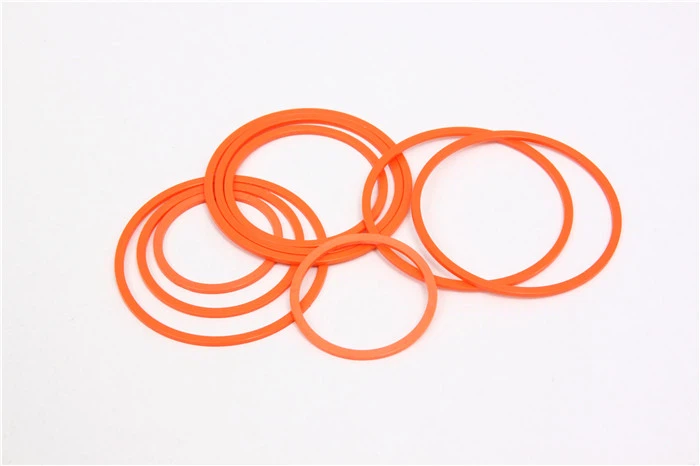
We also have a specialized type for vacuum applications: PTFE vacuum rings. Vacuum systems, used in semiconductor manufacturing, food packaging, and research labs, require seals that can hold a consistent vacuum level with no outgassing (release of tiny gas molecules). Pure PTFE is ideal here because it has extremely low outgassing, unlike rubber or plastic seals that can release volatile chemicals that contaminate the vacuum. PTFE vacuum rings are usually solid, because fillers can increase outgassing. They're designed to fit into vacuum flanges or pump ports, creating a hermetic seal that doesn't leak even under high vacuum (as low as 10^-12 Torr). I've supplied PTFE vacuum rings to a few semiconductor startups in recent years, and they swear by them for their cleanroom processes-even the smallest leak can ruin a batch of chips, so relying on high-quality vacuum rings is non-negotiable.
Now, how do you pick the right PTFE ring type for your application? As a supplier, I always ask customers three key questions: What's the pressure level? Is it a static or dynamic application? And what chemicals or temperatures will the ring be exposed to? Let's break it down. If you need a low-pressure static seal, go with solid PTFE. If it's high pressure (over 1,000 PSI), add a backup ring-our High Quality PTFE Back-up Ring is a great option here. For dynamic applications with high speed, go with carbon fiber-filled PTFE. For heavy industrial or offshore applications with extreme pressure, bronze-filled is the way to go. For vacuum or chemical processing, pure PTFE vacuum rings or solid PTFE O-rings will work. And for moving parts like shafts or cylinders, lip seals are the best choice.
I've worked with hundreds of customers over the years, and the biggest mistake I see is people using the wrong PTFE ring type for their job. I remember one customer who ran a small hydraulic repair shop that was using solid PTFE rings for heavy-duty construction cylinders. They were going through hundreds of rings a week, and their customers were complaining about leaks. We switched them to bronze-filled PTFE rings with our backup rings, and their replacement rate dropped by 80%. That's the difference between understanding the types of PTFE rings and just buying any PTFE part.
Another common mistake is buying cheap, low-quality PTFE rings from overseas suppliers. A lot of those aren't properly machined, have uneven filler distribution, or use low-grade PTFE that breaks down quickly under pressure. That's why I always emphasize working with a reputable supplier that tests their parts for pressure resistance, wear, and chemical compatibility. Our PTFE rings are precision-machined from virgin PTFE and high-quality fillers, and every batch goes through quality control checks to ensure they meet industry standards like ISO 9001 and ASTM D4894.
At the end of the day, PTFE rings might seem like a small component, but they play a huge role in keeping industrial, automotive, and aerospace systems running smoothly. Whether you're sealing a pipe in a chemical plant, a shaft in a pump, or a hydraulic cylinder on a construction truck, there's a PTFE ring type designed for your specific needs. If you're not sure which one is right for your application, don't guess-reach out to a supplier that knows their stuff. We're always here to help customers select the right PTFE ring, backup ring, or specialized seal for their project, no matter how big or small. Contact us today to discuss your sealing needs, and we'll work with you to find a solution that's reliable, cost-effective, and tailored to your application.
References
- Briscoe, B. J., & Adamson, M. J. (2001). Polytetrafluoroethylene (PTFE): Structure, properties, and applications. Polymer Reviews, 41(2), 149-188.
- American Society for Testing and Materials. (2019). Standard Specification for Polytetrafluoroethylene (PTFE) Extruded and Molded Shapes (ASTM D4894). ASTM International.
- Schick, M. J., & Hubbard, R. R. (2004). Seals and Sealing Handbook (5th ed.). Elsevier.
- Wang, H., et al. (2018). Filled polytetrafluoroethylene composites for tribological applications: A review. Tribology International, 126, 387-402.


