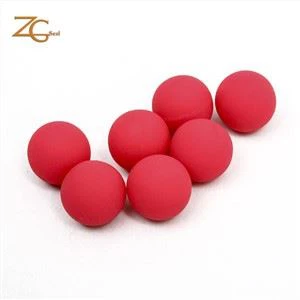
Q: What is the purpose of rubber balls?
A: Rubber balls are used in FDA uses, for games and sports, for light load-bearing applications. There are rubber balls used in the flow control and flowmeter applications in the pharmaceutical, food and chemical processing industries. For elliminating chatter or vibration in cabinetry, rubber balls are used.Over the years as an athletic trainer and public speaker, Carroll has transformed his philosophy into seven simple rules that any successful leader will endorse: 1) Commit to it 2) Seek out encouragers 3) Work out your creative muscle 4) Prepare to shine 5) Speak up 6) Expect the unexpected 7) Maximize the day With an.
Q: What are the characteristics of rubber balls?
A: Rubber balls made of natural rubber feature excellent mechanical properties. The balls are also resistant to abrasion, friction, compression and low temperatures.If this is your ultimate goal, then Size #32 Advantage Rubber Bands in a large half-pound bag or Size #117 Advantage File Bands (in a bright color assortment) are the best choices! Even better, you can find these on the shelf at most national retail stores.
Q: What sport uses a rubber ball?
A: Racquetball is a racquet sport and a team sport played with a hollow rubber ball on an indoor or outdoor court. Joseph Sobek invented the modern sport of racquetball in 1950, adding a stringed racquet to paddleball in order to increase velocity and control.Eight Ball is a call shot game played with a cue ball and fifteen object balls, numbered 1 through 15. One player must pocket balls of the group numbered 1 through 7 (solid colors), while the other player has 9 thru 15 (stripes). THE PLAYER POCKETING HIS GROUP FIRST AND THEN LEGALLY POCKETING THE 8-BALL WINS THE GAME.
Q: Do rubber balls bounce high?
A: When all three balls are dropped from the same height, the rubber ball will bounce the highest because it has the greatest elasticity. When the rubber ball hits the ground it gets compressed, or squished, and because it is very elastic, it quickly returns to its original shape.To keep rubber bands from drying out, you can store them in a cool, dark place away from sunlight and heat, as these can speed up the drying process. You can also keep them in an airtight container or plastic bag to prevent exposure to air, which can also contribute to drying.
Q: Can a rubber ball spin?
A: However if you use a super bouncy rubber ball, it grips the surface where it hits. This means that there must be a large frictional force on the ball which starts it spinning, in fact because the ball is elastic its spin bounces and it starts to spin the other way.Lowering the air pressure by lowering the temperature has an effect similar to deflating the ball. Increasing the temperature, and thus air pressure, has the effect of over-inflating (Portz, 2011}. The other way in which temperature influences the height a ball bounces is by impacting its elasticity.
Q: What is the rubber ball that doesn't bounce?
A: The “no bounce ” ball is made out of a special type of rubber (usually butyl rubber) that absorbs the kinetic energy of the falling ball instead of changing it into potential energy. For more on the science of Bounce No Bounce Balls and other Science Toys, visit the experiment.he air friction is approximately proportional to the square of the radius at high speeds, and to the radius at low speeds. So for bigger balls the ratio of gravitational to frictional force goes up, compared to small balls. That would tend to make the large balls bounce higher.
Q: Why is it called Indian rubber ball?
A: This material was first brought to the West by 18th century explorers of the Indies, who loaned the word India to the gummy substance, which was eventually dubbed rubber because of its ability to rub out pencil marks on paper. India rubber was grown commercially on plantations in South Asia by the end of the 1800s.
Q: Do rubber bouncy balls float?
A: Rubber balls for kids bring delightful and memorable moments each and every time. These high bouncing balls are able to float in water. It makes bouncy balls for children a great swimming pool and bath toy.One of the biggest limitations of natural rubber is its poor resistance to hydrocarbons, fats, oils, and greases. Contact with these substances can cause swelling, softening, or complete dissolution of the rubber part resulting in partial or complete failure.
Q: What are 3 natural rubber advantages?
A: Natural rubber is durable, abrasion resistant, vibration dampening, and costs less than many alternative polymers. Its great tensile strength and elongation make it an extremely tough and resilient material.In addition to excellent wear resistance, NATURAL RUBBER also offers low permanent set characteristics plus good flexing qualities at low temperatures. DISADVANTAGES: NATURAL RUBBER does not perform well when exposed to chemicals and petroleum derivatives, including petrochemicals.
Q: How do you soften rubber balls?
A: What will soften hard rubber? While sulfur was the original plasticizer for natural rubber, you can soften most modern rubber by allowing it to soak for at least 24 hours in a solution of three parts isopropyl alcohol and one part methyl salicylate. Spray the rubber with silicone spray.Once you have taken delivery of your rubber products, they should generally be stored in cold, dark, dry and oxygen-free conditions to slow the effects of rubber degradation.
Q: How are rubber band balls manufactured?
A: A rubber band ball is a sphere of rubber bands made by using a knotted single band as a starting point and then wrapping rubber bands around the center until the desired size is achieved.
Q: What is a type of ball with rubber strands?
A: The Koosh ball is a toy ball made of rubber filaments (strands) radiating from a steel-bound core, patented in 1987 by Scott H. Stillinger. The company later expanded their product line to include 50 other Koosh-related products, including keyrings, baseball sets, and yo-yos.Over time, rubber loses its ability to stretch, becoming hard and brittle. This process of perishing occurs because exposure of the rubber to light and air induces chemical changes in the polyisoprene over time.
Q: Why do rubber bands become brittle?
A: Cold temperatures make rubber bands brittle and prone to snapping. Oxygen and UV light break the rubber down over time, and eventually the band loses its elasticity—which is why outdoor rubber bands are typically made to be UV and ozone resistant to help prolong their lifespan.A ball may be played three times on one side providing the same player does not touch the ball twice in succession. EXCEPTIONS: A. A ball hit simultaneously by two team mates is considered as one hit, and either player may contact the ball a second time.
Q: How do rubber balls work?
A: Store-bought bouncy balls are made of rubber, another material that is made up of polymers. When the bouncy ball is stretched, these polymer chains uncoil and straighten. When released, the chains coil back up again. This makes the material stretchy and bouncy.Over the years as an athletic trainer and public speaker, Carroll has transformed his philosophy into seven simple rules that any successful leader will endorse: 1) Commit to it 2) Seek out encouragers 3) Work out your creative muscle 4) Prepare to shine 5) Speak up 6) Expect the unexpected 7) Maximize the day With an
Q: Why do some rubber balls bounce more than others?
A: A ball's ability to bounce has a lot to do with its elasticity. So what is elasticity? It's an object's ability to return to its original shape after being stretched or squeezed. Objects that are more stretchy are usually more elastic, too.Because bouncy balls are elastic, the molecules will want to return to their original shape. The energy of the downward motion of the ball will be converted into upward motion as the molecules spring back into their original shape.
Q: Why are rubber balls so bouncy?
A: When a rubber ball is squeezed, the curly rubber molecules stretch out, but then quickly return to their curlier shape which makes the ball bounce. The flexible rubber on sneakers and tires squeezes into the tiny uneven surfaces of roads and sidewalks and helps the shoe and tire grip with less slipping.Well-vulcanized rubber does not crystallize, but loses its ability to retract when stretched. Crude or elastic rubber, however, loses elasticity completely if cooled to 70-80° F. below zero. If bent suddenly at right angles a glass-like breakage occurs.
Q: What is a rubber ball?
A: A bouncy ball or rubber ball is a spherical toy ball, usually fairly small, made of elastic material which allows it to bounce against hard surfaces.Rubber balls are used in FDA uses, for games and sports, for light load-bearing applications. There are rubber balls used in the flow control and flowmeter applications in the pharmaceutical, food and chemical processing industries.
Q: Is a rubber ball bouncy?
A: When a rubber ball is squeezed, the curly rubber molecules stretch out, but then quickly return to their curlier shape which makes the ball bounce.
Store-bought bouncy balls are made of rubber, another material that is made up of polymers. When the bouncy ball is stretched, these polymer chains uncoil and straighten. When released, the chains coil back up again. This makes the material stretchy and bouncy.
Q: Do rubber balls bounce high?
A: When all three balls are dropped from the same height, the rubber ball will bounce the highest because it has the greatest elasticity. When the rubber ball hits the ground it gets compressed, or squished, and because it is very elastic, it quickly returns to its original shape.Because bouncy balls are elastic, the molecules will want to return to their original shape. The energy of the downward motion of the ball will be converted into upward motion as the molecules spring back into their original shape.
Q: Can a rubber ball spin?
A: However if you use a super bouncy rubber ball, it grips the surface where it hits. This means that there must be a large frictional force on the ball which starts it spinning, in fact because the ball is elastic its spin bounces and it starts to spin the other way.Balls bounce due to the elasticity of the material they are made from. The best materials for bouncing are the ones that can stretch like an elastic band and then go back to their original shape quickly and easily. Some materials, like rubber, are very elastic, and therefore bounce easily.